The chemistry behind grease clogs
Fats and oils leave the sink warm and liquid. Within a few feet they cool, become sticky, and cling to the pipe. Over time, free fatty acids in the grease react with calcium and other minerals in the water — a process similar to how soap is made — forming a hard, waxy deposit that bonds to the pipe wall. Each new layer of grease sticks to the last, and food particles get trapped in it.
Water hardness matters here. Whittier’s water comes largely from groundwater wells, and the City’s published water quality reports have shown average hardness around 290 mg/L as calcium carbonate — firmly in the “very hard” range. More dissolved minerals means more material available to harden grease into scale.
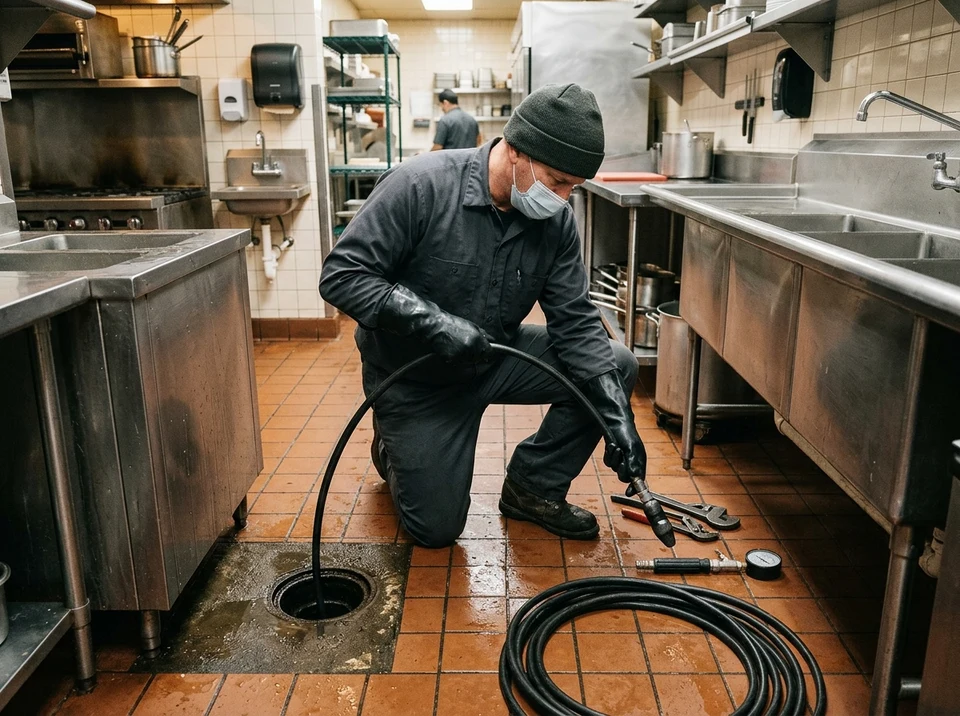
Where grease accumulates in a commercial kitchen
- Three-compartment and prep sinks — the highest-volume grease sources.
- Dishwasher discharge — hot water keeps grease liquid until it hits cooler pipe downstream.
- Floor drains and floor sinks — they collect mop water, spills and debris.
- The run to the grease interceptor — grease hardens before it ever reaches the device.
- Bends, low spots and long horizontal runs — where flow slows and solids settle.
What a grease backup really costs
For a restaurant, the plumbing bill is the smallest part of a backup. Closing a dining room during a dinner rush, discarding food, cleaning up contaminated floors, and the possibility of a health inspection finding all add up quickly. Backups also tend to happen at the worst time — when the kitchen is busiest and sending the most grease down the drain.
Call now to discuss jetting before it turns into a closed dining room.
Interceptor pumping vs. line jetting
These are two different services, and kitchens need both:
| Grease interceptor pumping | Hydro jetting the lines | |
|---|---|---|
| What it does | Empties accumulated grease and solids from the interceptor | Removes grease coating from the pipes |
| Protects | The public sewer downstream | Your kitchen’s drain lines |
| Typical frequency | Set by size, volume and local requirements | Set by how fast buildup returns |
Food service establishments in this area are generally required to have and maintain an approved grease control device. Requirements are set by the local sewer agency — the City of Whittier within city limits, or Los Angeles County Public Works in unincorporated areas. If you’ve received a notice from an inspector, keep it handy when scheduling service.
Kitchen practices that make the biggest difference
- Dry wipe before washing. Scrape plates and wipe pans and fryers with paper towels; grease into the trash is grease not in the pipe.
- Collect used fryer oil in a dedicated container for a rendering or recycling service.
- Keep strainers in every sink and floor drain, and empty them into the trash, not the sink.
- Don’t pour grease down with hot water or rely on degreasers to “wash it through” — it hardens farther down the line.
- Train new staff on day one. Turnover is the biggest threat to good habits.
- Post simple signage at sinks: “No grease. Scrape and wipe first.”
Setting a jetting schedule
Start with a thorough cleaning and a camera inspection to record the baseline. Re-inspect after a set period — often three months for a high-volume kitchen — and adjust: if the line is still clean, stretch the interval; if buildup is heavy, shorten it. Fryer-heavy kitchens commonly land on quarterly jetting; lighter operations may need it every six to twelve months.
Frequently asked questions
How often should a restaurant jet its drain lines?
High-volume, fryer-heavy kitchens often need quarterly cleaning; lighter operations may need six to twelve months. Camera inspections help set the interval.
Can enzymes or bacteria products replace jetting?
They may slow light buildup as part of maintenance, but they don’t remove hardened grease deposits and don’t replace interceptor maintenance.
Who is responsible for grease in a shared commercial line?
Usually the lease defines it. Typically each tenant maintains its own fixtures and lines, while the property owner handles shared mains.
Related services
- Commercial Hydro JettingRestaurants, retail centers, apartments and offices — high-volume lines jetted on a schedule that keeps your doors open.
- Grease & Sludge RemovalHardened grease and sludge scoured off the pipe wall — the kind of buildup a snake leaves behind.
- Preventive Drain MaintenanceScheduled jetting for restaurants, apartments and older homes — set by what the camera shows, not a sales calendar.
Call Precision Hydro Jetting. Describe the symptoms and get a straight answer on next steps.
Sources
- City of Whittier — Annual Water Quality Report (2017)
- LA County Public Works — Sewer Maintenance Customer Information

Precision Hydro Jetting — drain and sewer cleaning for Whittier, CA. This guide is general information, not a diagnosis of a specific plumbing system; conditions vary by property.